Blog
Prop firms have become one of the most popular entry points into trading. They promise something very attractive: access to large trading capital without risking your own money. Because of this, many traders assume they are the fastest way to grow a trading account. But when you look at the numbers and the reality behind how traders actually perform, the picture becomes more balanced.
How Prop Firms Actually Work
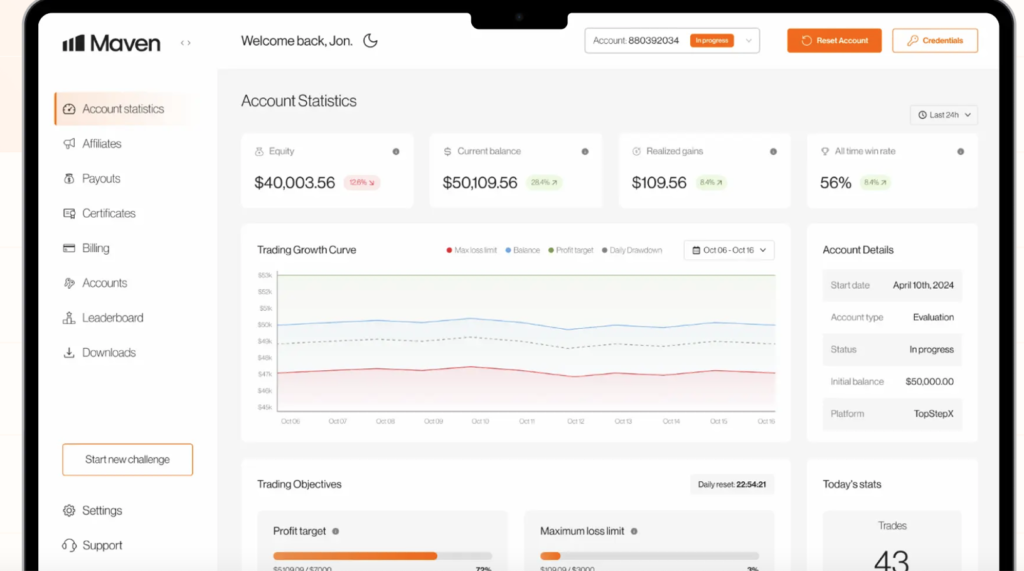
A prop firm gives traders funded capital after they pass an evaluation process. This usually involves hitting a profit target while staying within strict risk limits such as daily loss caps and maximum drawdown rules. Prop firms allow traders to:- Trade with funded capital (often $10,000 to $200,000+)
- Keep a share of the profits (commonly 70%–90%)
- Pay a fee to pass an evaluation before getting funded
- Daily loss limits
- Maximum drawdown
- Profit targets

What the Data Shows
Across the trading industry, prop firm performance statistics are surprisingly consistent. Only about 5% to 10% of traders pass their first evaluation, while the majority fail due to breaching risk limits or inconsistent execution. Even more striking is that only a small percentage, roughly 7%, go on to receive consistent payouts after funding. Over time, many traders drop out entirely. Around 60% to 70% fail within the first few months, and only about 10% to 15% become consistently profitable.Visual Breakdown of Trader Outcomes
Here is a simple representation of what typically happens when 100 traders start a prop firm challenge:100 Traders Start ├── 90–95 fail the evaluation stage ├── 5–10 get funded └── 1–7 receive consistent payouts
Over a longer period, the distribution looks even more selective:
100 Traders Over Time ├── 60–70 quit or blow accounts early ├── 20 remain inconsistent or break even └── 10–15 become consistently profitable
Why Prop Firms Feel Like a Shortcut
The appeal of prop firms is understandable. You can access large capital quickly without needing years of account growth. This creates the impression that you can scale fast if you just pass an evaluation. However, what many traders underestimate is the pressure that comes with it. Strict drawdown rules mean that even small mistakes can lead to failure. As a result, traders often begin to overthink trades, cut winners too early, or revenge trade after losses. Instead of simplifying trading, prop firms often amplify emotional weaknesses.
The Real Factor Behind Success
When you remove the structure and rules, one thing becomes clear: prop firms don’t create profitable traders. They only reveal them. Traders who already have discipline, consistency, and a tested strategy tend to succeed. Those who are still emotional or inconsistent usually struggle, regardless of the opportunity. This is why some traders pass quickly while others remain stuck in repeated evaluation cycles.So, Are Prop Firms the Fastest Way to Grow?
The honest answer is that it depends on the trader, not the prop firm. For a trader who already understands risk management and has a consistent strategy, prop firms can accelerate growth by providing access to larger capital. But for beginners, the same structure often slows progress because it exposes weaknesses too early.
Final Thoughts
Prop firms are not a shortcut to profitability. They are more of a performance filter. They reward traders who already have structure and discipline, and they expose those who do not. So while prop firms can be a powerful tool, they are not inherently the fastest way to grow a trading account. The fastest growth still comes from mastering consistency first, because without it, no amount of capital will make trading easier.